
EV Charging Levels Explained: Level 1, Level 2 and DC Fast Charging
By Staff Writer · October 8, 2026
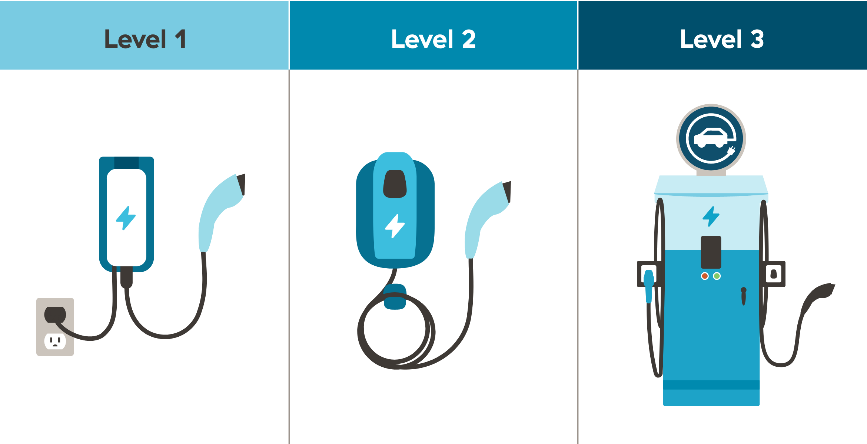
Choosing the right EV charging option starts with understanding the different EV charging levels. Level 1, Level 2 and DC fast charging are designed for different situations, from overnight charging at home to rapid charging during a long road trip. The biggest differences involve electrical power, charging speed, installation requirements and where each type is normally used.
Level 1 uses a standard 120-volt household outlet and provides the slowest charging. Level 2 uses higher-voltage AC power and is common in homes, workplaces and public locations. DC fast charging delivers electricity directly to the vehicle’s battery at much higher power and is primarily used for public and highway charging. Understanding these differences can help EV drivers choose the right charger for everyday driving and longer trips.
What Are the Different EV Charging Levels?
EV charging equipment is generally classified according to how quickly it can deliver electricity to an EV. In the United States, the three charging categories most drivers encounter are Level 1, Level 2 and DC fast charging.
The U.S. Department of Energy’s Alternative Fuels Data Center identifies Level 1 as 120-volt AC charging, Level 2 as 208- or 240-volt AC charging, and DC fast charging as high-power charging that can provide substantially more energy in a shorter period. Actual charging times depend on the vehicle, battery size, state of charge and charging equipment.
It is important to remember that a charging level describes the charging equipment, not a guaranteed charging speed for every EV. Two vehicles connected to the same charger can charge at different rates because their onboard charging systems and battery architectures differ.
What Is Level 1 EV Charging?
Level 1 is the simplest form of EV charging. It uses a standard 120-volt AC household outlet and typically requires no dedicated charging equipment beyond the portable cordset supplied with many EVs.
The DOE estimates that Level 1 charging can add approximately 2 to 5 miles of range per hour, depending on the vehicle and charging conditions. Its relatively low power makes it best suited to vehicles that remain parked for extended periods.
For example, an EV parked overnight for eight hours could gain roughly 16 to 40 miles of range, although actual results vary. A smaller battery or plug-in hybrid may be particularly well suited to this charging method.
Where Is Level 1 Charging Used?
Level 1 is most commonly associated with residential charging. It can be useful for drivers with short daily commutes, low daily mileage or sufficient overnight parking time.
It can also be useful when an EV driver does not want to install a dedicated Level 2 charger. The DOE notes that many EV owners can meet their daily driving requirements with overnight Level 1 charging when an appropriate outlet is available.
Level 1 is less common at public charging locations because drivers generally expect faster charging when they leave home to charge.
What Is Level 2 EV Charging?
Level 2 charging uses 208- or 240-volt AC electrical service and provides considerably more power than Level 1. It is widely used for residential, workplace and public charging.
The DOE’s AFDC estimates that Level 2 can add approximately 10 to 30 miles of range per hour, although charging equipment can range from roughly 2.9 kW to 19.2 kW. The actual rate depends on both the charger and the vehicle’s maximum AC charging capability.
For many EV owners, Level 2 provides the best balance between charging speed, installation requirements and everyday convenience.
Why Is Level 2 Popular for Home Charging?
Level 2 can replenish a typical EV battery overnight, making it particularly useful for drivers with longer commutes or higher daily mileage.
A residential Level 2 charger generally requires appropriate 240-volt electrical service and installation by a qualified electrician. The home’s existing electrical capacity also needs to be considered before installation.
Level 2 equipment is available with features such as scheduling, energy monitoring and network connectivity. Smart charging can allow drivers to schedule charging around electricity rates or their expected departure time.
Where Can You Find Level 2 Chargers?
Level 2 chargers are common in places where vehicles remain parked for relatively long periods. These include homes, workplaces, hotels, shopping centers, parking facilities and other destinations.
The DOE identifies Level 2 as the most common type of workplace charging equipment.
For public charging, Level 2 is often a practical option when drivers plan to spend an hour or several hours at a destination rather than needing an immediate high-power charge.
What Is DC Fast Charging?
DC fast charging is designed to deliver much more power than Level 1 or Level 2 AC charging. Instead of supplying AC electricity that the vehicle’s onboard charger converts to DC, DC fast-charging equipment supplies DC power to the vehicle’s battery system.
The DOE says DC fast chargers can provide approximately 100 to 200 or more miles of range in 30 minutes, depending on the vehicle and charging equipment. Modern equipment can reach power levels of up to 500 kW, although the vehicle may accept considerably less.
DC fast charging is commonly found at highway rest areas, travel corridors, urban charging hubs and other locations where drivers need to replenish substantial range quickly.
Is DC Fast Charging the Same as Level 3 Charging?
You may see DC fast charging described as “Level 3 charging.” The terminology can be confusing because the U.S. charging infrastructure commonly discussed by consumers is divided into Level 1, Level 2 and DC fast charging.
For practical purposes, EV drivers should focus on the charger’s power output, connector compatibility and their vehicle’s charging capability rather than relying solely on the phrase “Level 3.”
DC fast chargers can have significantly different power ratings. A 50-kW charger and a 350-kW charger are both DC fast chargers, but they can provide very different charging experiences.
What Is the Difference Between Level 1, Level 2 and DC Fast Charging?
The primary difference is how much electrical power each charging type can deliver and how quickly the vehicle can replenish its battery.
Level 1 is the slowest and simplest option. It works well for overnight charging and low daily mileage. Level 2 provides substantially faster AC charging and is often the most practical choice for routine home charging. DC fast charging provides the highest charging power and is intended primarily for rapid charging during travel or when an EV needs significant range in a short period.
The DOE estimates approximately 2–5 miles of range per hour for Level 1, 10–30 miles per hour for Level 2, and 100–200+ miles in 30 minutes for DC fast charging. These are general estimates rather than guarantees because vehicle and battery characteristics strongly affect charging performance.
Which EV Charging Level Is Best for Home?
For most drivers, the choice between Level 1 and Level 2 depends on daily mileage and how long the vehicle remains parked.
Level 1 may be sufficient if you drive relatively few miles each day and have many hours available for overnight charging. It can also avoid the cost and installation work associated with a dedicated charging station.
Level 2 is generally more suitable when you drive more frequently, have a longer commute, own an EV with a larger battery or want to replenish the battery faster between trips.
DC fast charging is generally not necessary for routine overnight home charging. It requires significantly more powerful infrastructure and is primarily associated with public charging.
Which EV Charging Level Is Best for Road Trips?
DC fast charging is usually the most practical option for long-distance EV travel because it can add substantial range during a relatively short stop.
A road-trip charging strategy may involve stopping at a DC fast charger when the battery reaches a lower state of charge, adding enough energy to continue the journey, and then moving on rather than waiting for a full charge.
The exact charging time depends on the vehicle’s battery temperature, state of charge, charging curve and maximum DC charging capability. A charger advertised at 350 kW does not mean every EV connected to it will receive 350 kW.
Does a Higher kW Rating Always Mean Faster Charging?
No. Charger power is only one part of the charging equation.
An EV can only accept as much power as its charging system and battery allow under current conditions. If a vehicle has a maximum DC charging rate below the charger’s advertised output, it will not receive the full charger rating.
Charging speed can also decline as the battery approaches a higher state of charge. This is why a vehicle may charge very quickly at a lower battery percentage but slow down considerably as it approaches its upper limit.
The DOE specifically notes that charging time depends on factors including battery state of charge, battery capacity, battery type, onboard charger capacity and charging equipment.
What Connectors Are Used for Different Charging Levels?
Connector compatibility is another important difference between charging levels.
Level 1 and many Level 2 chargers use the SAE J1772 connector in North America. Vehicles equipped with the NACS, formally standardized as SAE J3400, can also use that connector for AC charging.
DC fast charging uses connectors such as CCS, CHAdeMO and NACS/J3400. The exact connector required depends on the vehicle and charging station.
Drivers should always confirm connector compatibility before selecting a public charger. Adapters can expand charging options for some vehicles, but their compatibility and supported charging power depend on the vehicle and adapter.
How Much Does Each EV Charging Level Cost?
Charging costs are not determined solely by the charging level.
At home, Level 1 and Level 2 charging are generally billed through the driver’s electricity utility, so the primary cost is the applicable electricity rate. Installation and equipment costs can also affect the overall cost of home charging.
Public Level 2 and DC fast charging can have different pricing structures. Networks may charge by the kilowatt-hour, by time, through session fees or according to other location-specific pricing models.
DC fast charging can cost more than Level 2 public charging because high-power charging infrastructure is more expensive to install and operate. The DOE notes that public DC fast-charging equipment can have substantially higher infrastructure costs than Level 2 equipment.
Before using a public charger, check the current price in the network’s app or at the station.
Can You Use Level 1, Level 2 and DC Fast Charging With the Same EV?
Most modern battery-electric vehicles can use multiple charging levels, provided the appropriate connector and equipment are available.
For example, an EV may use Level 1 or Level 2 AC charging at home and DC fast charging during road trips. However, plug-in hybrid vehicles are not universally capable of DC fast charging. The DOE notes that most PHEVs cannot use DC fast charging.
The vehicle owner’s manual or manufacturer’s specifications should be used to confirm maximum AC and DC charging capabilities.
How Should You Choose the Right EV Charging Level?
The best charging level depends on your driving pattern rather than simply choosing the fastest available option.
For everyday charging, Level 1 can be adequate for low-mileage drivers with long parking periods. Level 2 is generally a better fit when faster overnight charging is needed. DC fast charging becomes particularly valuable for road trips, long-distance driving and situations where an EV needs significant additional range quickly.
Using an EV charging directory can help you identify compatible Level 2 and DC fast charging stations by location, network, connector type and charging category before you travel.
The Right Charging Level Depends on How You Drive
There is no single EV charging level that is best for every driver. Level 1 prioritizes simplicity, Level 2 offers a practical balance for everyday charging, and DC fast charging prioritizes speed when drivers cannot spend several hours parked.
For many EV owners, the most effective approach is to use Level 1 or Level 2 for routine charging and reserve DC fast charging for longer journeys or situations where time matters. Understanding your vehicle’s charging limits and the capabilities of available stations can help you charge more efficiently and avoid paying for more charging power than you actually need.
Frequently Asked Questions
What are the three main EV charging levels?
The three charging categories most commonly discussed in the United States are Level 1, Level 2 and DC fast charging. Level 1 uses 120-volt AC power, Level 2 generally uses 208- or 240-volt AC power, and DC fast charging supplies high-power DC electricity directly to the vehicle's battery system.
Is Level 2 charging faster than Level 1?
Yes. Level 2 provides substantially more power than Level 1. The DOE estimates approximately 10–30 miles of range per hour for Level 2 compared with about 2–5 miles per hour for Level 1, although actual performance varies by vehicle and equipment.
Is DC fast charging the fastest type of EV charging?
DC fast charging is generally the fastest charging option available to consumers for public EV charging. Modern DC fast chargers can provide very high power, but the vehicle determines how much power it can actually accept.
Can I charge my EV with Level 1 every night?
Yes. Level 1 can be sufficient for drivers with relatively low daily mileage and enough overnight parking time. The DOE notes that many EV owners can meet their daily driving needs using overnight Level 1 charging.
Is Level 2 charging better than Level 1 for home use?
It depends on your driving needs. Level 1 can be adequate for low-mileage drivers, while Level 2 is generally more convenient for drivers who need to replenish more range overnight or during shorter parking periods.
Does a 350 kW charger charge every EV at 350 kW?
No. The vehicle's maximum charging capability, battery condition, state of charge and other factors determine actual charging power. A high-power charger can provide up to its rated output, but the EV may accept considerably less.
Do all EVs support DC fast charging?
No. Most battery-electric vehicles support DC fast charging, but capability varies by vehicle. Many plug-in hybrid vehicles do not support DC fast charging.
Which EV charging level should I use for a road trip?
DC fast charging is generally the most practical choice for long-distance travel because it can replenish substantial range in a relatively short stop. Level 2 can still be useful at hotels, destinations or other locations where you plan to stay for several hours.
No reviews yet — be the first to share your experience.